


So here’s what happened this week
Yesterday, my friend Lauren pulled up a visual during a call we were on together.
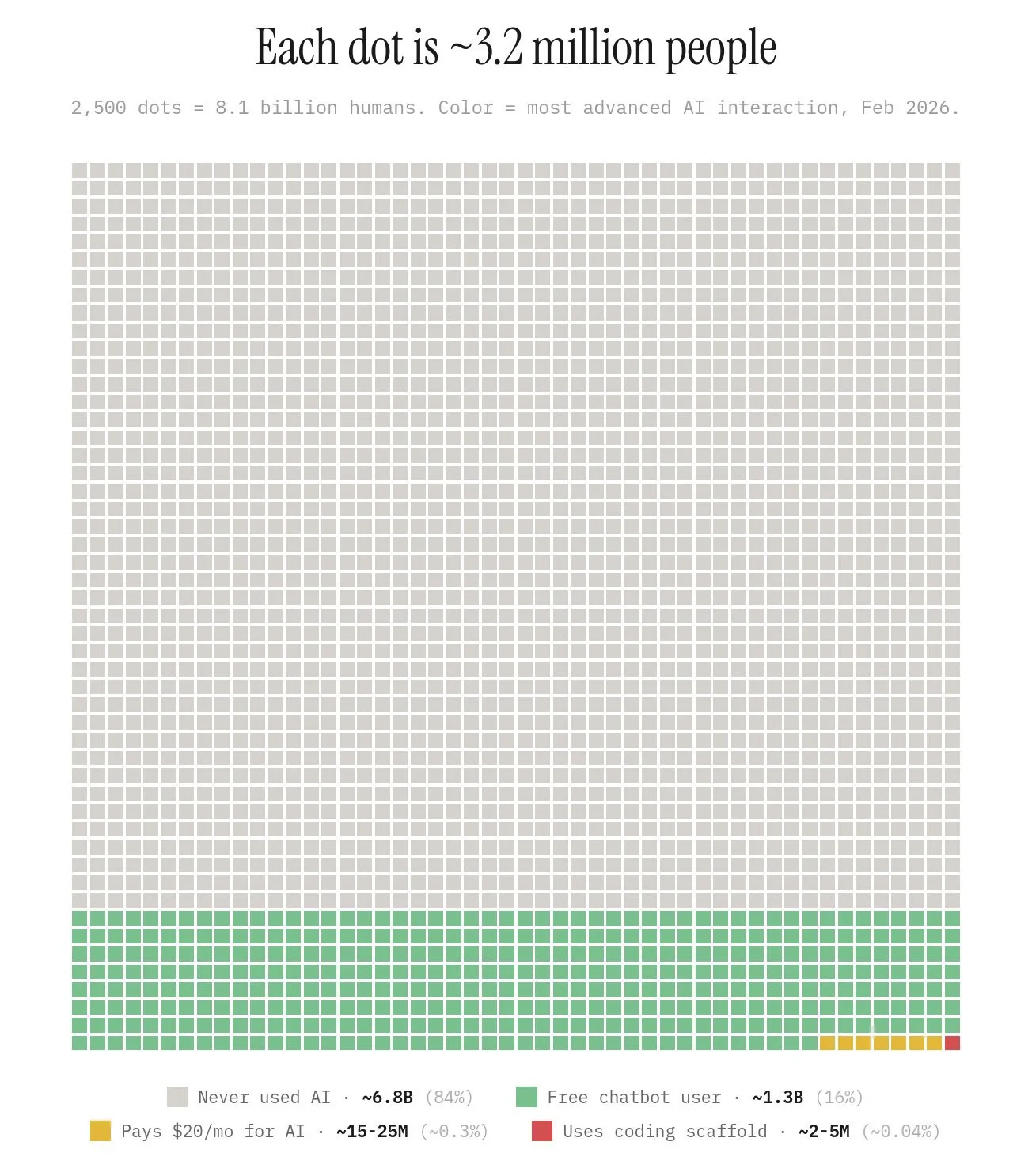
Each dot represents 3.2 million people. The whole grid is 8.1 billion humans - everyone alive on the planet right now.
Gray: never touched AI. That’s 84% of the grid. 6.8 billion people.
Green: using a free chatbot. ChatGPT, Claude, whatever. That’s the bottom few rows. 1.3 billion people, about 16%.
Yellow: paying $20 a month for AI access. A tiny sliver. 15 to 25 million people. 0.3%.
Red: using coding scaffolds, agentic workflows, building with AI at a high level. You can barely see it. 2 to 5 million people. 0.04%.
I’ve had this conversation - or some version of it - more times than I can count over the past couple of years. But I’m a visual person, and something about seeing it laid out this way stopped me cold.
Because the world isn’t changing at the pace of the gray. It’s changing at the pace of the red (and to an extent, yellow).
Where I think most people have it wrong.
When someone who isn’t yet using AI hears that they’re “falling behind,” the instinct is to push back. And the pushback usually sounds like this: This is just marketing hype. I’ll catch up when I’m ready. The tools will be easier to use by then. It’s not that hard.
My friend Lauren said it best:
“That’s like thinking a high school runner can close the gap on an Olympic athlete who’s been training for years just because the track gets smoother.”
The gap isn’t about how hard the tools are to use. It’s about something that can’t be downloaded.
The people inside that red sliver - and honestly, even the yellow - haven’t just learned software. They’ve gone through cycle after cycle of unlearning and relearning.
Every few months, something shifts so fundamentally that it forces a complete rebuild of how they were thinking about a problem.
A delivery model. A product. A business structure.
The possibilities that are visible to them now are genuinely invisible to someone who hasn’t been inside it.
I’m not saying this from a distance. I’m saying this as someone who is building right now, in real time, and who is still getting her mind blown on a near-weekly basis.
Ten days ago, I was deep in building out a specific piece of how we deliver results inside Client.RetentionOS (the actual implementation process our clients go through to increase their client retention and build an ecosystem that grows their business from within instead of relying solely on paid ads and organic content).
I had a working approach. It was good. I was refining it.
Then a new update dropped.
And suddenly there was a faster path. A better one. One that would get clients to results in a fraction of the time, with less friction, with better outcomes. Not a small tweak, I’m talking fundamental rethink of how that piece of the work gets done.
I had to go back to the drawing board mid-build because the ground shifted underneath our offer delivery and created a brand new opportunity.
That is what living inside AI actually looks like. Not “I used it to write a caption.” Constant reconstruction of what’s possible. Every few weeks, a new version of what you thought you understood.
And here’s what keeps me up at night when I think about the people in the gray zone of that image above:
They haven’t had to do that yet. Not once.
The unlearn/relearn cycle that the people in that red sliver have already been through dozens of times - they haven’t started it. And when they do, they won’t be starting from the same place everyone else started from two years ago. They’ll be starting from a moving target that is now moving much, much faster every single day.
What this mean for the market your business operates in?
Think about the barrier that used to exist between having an idea and going to market with a service. You needed time, capital, infrastructure, at minimum a few months of setup.
That barrier is gone.
Someone with a skill and a weekend can now have a credible offer in front of buyers by Monday.
At the same time, we are heading into the biggest white collar layoff in history.
People with mortgages, careers, real expertise - they’re not going to find new corporate jobs. They’re going to build something. And I can tell you from having multiple business model conversations this month with many of them, they are already preparing.
Some of them are writing five-figure checks right now to figure out their next move before the layoff happens.
The biggest new business wave has already starting. And every one of those people is entering a market that AI just made infinitely easier to enter.
More providers. More offers. More people who look credible overnight. More noise in every channel your clients use to make decisions.
Think about what that does to trust. Think about what it does to your clients’ ability to figure out who to listen to, who to hire, who to refer to their network.
I have never doubted so much of what I see online. Everything feels manufactured. Everything looks polished. And because of that, I have never relied more heavily on the people in my circle to tell me who they actually trust.
That instinct? My clients and your clients have it too, more than ever.
So what do you do with all of this?
I’m not going to pretend there’s a clean five-step answer.
What I will say is that the service businesses that are going to hold ground through this (not just survive, but actually build something that stands the test of time and grows in this new economy) understand that the trust people have already placed in them is the most valuable thing they own right now.
New acquisition is getting harder and more expensive in real time. Your existing clients already trust you. They’ve seen your work.
In a market flooded with options, they are actively looking for someone whose judgment they can rely on: for what comes next after working with you, for who to hire for the adjacent problem they now have, for where to turn when they can’t figure out who to believe.
That’s not just a relationship. That’s an actual trust and revenue engine, if you build it that way.
The firms I work with who are growing without burning themselves out on acquisition stopped treating the end of an engagement as the end of the relationship. They have visibility into where their clients are in their journey. They have a next step mapped. They have partners they trust enough to refer to. And those partners refer back.
That’s not a complex system. It’s a decision to see your existing client base as an asset that grows and pays dividends to all parties involed, instead of a list that depletes over time.
Whether that’s something you’re ready to build right now or just starting to think about, I’m glad you’re thinking about it. Because the window for getting ahead of this is not as wide as most people think.
If you want to talk about what this infrastructure looks like inside your firm, comment OS below or reply directly to this email.
And do me a solid, share this piece with your business besties who need to understand what is coming. I’m not a hype girl, believe me. But I will say it like it is - and this is coming.
The world is moving. You already know that. The question is just what you’re building while it does.
— Khaïry
Co-founder, AI District | Industry Rockstar Venture Studios AI-Powered Retention Infrastructure. Zero-CAC Revenue. Compounding Growth.
PS: Please reply or comment any question about these trends, so I can create additional content for you. I want to see you win and I’m here to support and share everything I know.
Thank you for your thoughtful piece here, Khaïry.
I had an interior designer come over. To prepare for our meeting, I used Chat GPT, uploaded an image of my living room, and prompted/experimented different styles. Worked shockingly well.
When designer saw my work, her reply was “OMG AI is going to take my job.” Then she said my design project was too small for her, and I should just keep using Chat GPT.
So I did. Not only did it give me looks, but I also got it to give me a shopping list. I’ve now spent and few thousand on new items for my living room, all inspired by ChatGPT.
The next day, I texted her to offer her help on how AI could be an opportunity, not a threat. She shrugged her shoulders, “oh, I’m probably look into that later in the year.”
She just lost a few thousand dollars by not taking my project. She saw what AI could do. And still she just shrugged.
Astonishing.